

With Amsterdam’s Cello Biennale in full swing across the city at the Muziekgebouw aan’t IJ, not to be outdone, the Concertgebouw hosted its very own cello extravaganza. Where else in the world can you hear three of the finest proponents of their art – Kian Soltani, Nicolas Altstaedt and Alisa Weilerstein – perform three very different concertos, on the same day? One, a world premiere, another a European premiere and the third, some might regard as a game-changer. Joining the NTR Saturday Matinee stage, Elena Schwarz and the Radio Philharmonic Orchestra were followed later that evening by the Netherlands Philharmonic Orchestra conducted by Hannu Lintu. This had the makings of an unforgettable day of music making to rival cities across the world.
The programmes

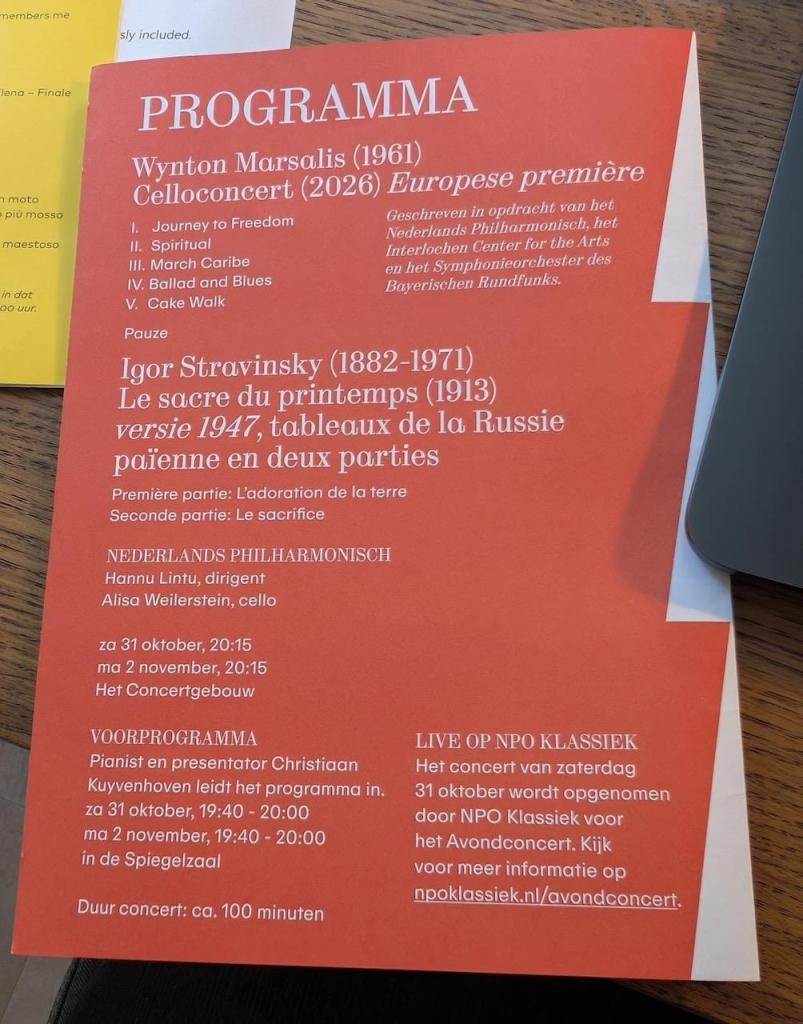
Hearing three different concertos for the same instrument played back-to-back, allows comparisons. Seen through the lens of three distinctive contemporary voices – Iranian Amsterdam-based Aftab Darvishi, the late Polish pioneer Witold Lutosławski, and American jazz legend Wynton Marsalis – elevated the form, leading it in contrary directions. Yet within such diversity, there was much to unite. The cadenza’s increasingly pivotal role in allowing full expression amidst sometimes thick orchestral textures cannot be ignored. And how, in the hands of especially Darvishi and Marsalis with their extensive use of melodies, harmonies and ornamentation referencing explicit and specific times and place, music transcends literature’s ability to document cultural and historical change with such searing and heartfelt passion that for those precious few hours within the confines of a concert hall, anything seemed possible. Each work, poles apart in terms of language, yet equally compelling.
Kian Soltani premieres Aftab Darvishi’s Cello Concerto at the Concertgebouw
The world premiere of In Absence (a co-commission with the Cello Biënnale) given by Kian Soltani and the Radio Philharmonic referenced Darvishi’s personal reflections on the Iran-Iraq war (1980-1988) which loomed large over much of her life as she grew up “surrounded by those who carry its wounds”. Starting with an extended cadenza, Soltani’s opening cries gave a very Eastern flavour. Overflowing with longing, falling fragments seemed to morph seamlessly into fervent arpeggios. The cello, a symphony of sound drawing on the language of Bach’s cello suites, yet Darvishi’s voice remained totally her own.
How could the orchestra possibly match the beauty of those searching, and now rising intervals? Breaking the spell, woodwind and horn flutters rose to the challenge as glissando cello harmonics created a very distant eeriness.
A much busier and darker ‘I don’t remember war, but war remembers me’ second movement emerged. Darvishi’s succinct writing found the protagonist fighting for his life, fleeing from an ensuing military storm with only chiming crotales to light the way. Colourful orchestration and luxurious harmonies mixed with wailing sirens created a dramatic end. In turn, melancholic winds offered flickers of hope leaving Soltani’s intensely lyrical melodies to forge a brighter tomorrow.
In Absence is simply divine, and in the hands of Soltani, the master storyteller, I imagine it will grace many a stage.
Nicolas Altstaedt plays Witold Lutosławski
Lutosławski’s concerto (1970) written fifty-six years before, similarly opens with an extended cadenza: initially more of a ticking clock. In Altstaedt’s hands, angular and intense protestations summoned a clever and witty riposte with one, then two, then finally three different notes exploring a multitude of rhythmic effects. Schwarz navigated a clear path through Lutosławski’s harsh mêlée full of improvisatory turns while Altstaedt’s intensely chocolatey darkness left this listener longing for more. Their language, a world away from the usual concerto-fare of Dvorak and Elgar. Building to a cataclysmic climax, one wondered if the end of the world was actually nigh, yet the purgatory continued. The lonesome cello, pummelled by incessant hammer blows, unwillingly accepted compromise, and a ceasefire ensued. Such vivid storytelling from master storyteller number two.
Alisa Weilerstein plays Wynton Marsalis
Gracing the stage for the evening’s European premiere of Wynton Marsalis’ Cello Concerto with the Netherlands Philharmonic under guest conductor Hannu Linti, Alisa Weilerstein descended the Concertgebouw stairs wearing a stunning couture CD Green red jumpsuit – think Jennifer Lopez. She looked amazing.
Adding to his growing oeuvre in this genre: the 2015 Violin Concerto for Nicola Benedetti and 2023 Trumpet Concerto for Michael Sachs (heard here in June performed by Miro Petkov and the Concertgebouw Orchestra), Marsalis’ new Cello Concerto – premiered earlier this year by Yo-Yo Ma and Cristian Mǎcelaru with students from the Interlochen Centre for Arts, Michigan – lasts a staggering fifty minutes. He rarely gives the cellist time to breathe. Instead, in a mix of quaint and more familiar fragments, he positions the cello as a lone voice amidst a dense, colourful and at times chaotic orchestral texture.
Charting America’s rich and varied history, Marsalis blends harsh metallic sounds with piercing whistles, neighing horses, sandpaper shuffles and marching slaves fighting their very own battles in his ‘Journey to Freedom’.
His harmonic language is equally eclectic, saving negro spirituals for his most lyrical moments yet seemingly unable to resist the temptation to make them his own. ‘March Caribé’s’ circus-like calypso grooves vie with ‘Cake Walk’s’ funky, comic bass lines. A positive melting pot of musical styles.

© Eduardus Lee
The challenge
The soloist’s challenge is threefold. To hit those jazzy grooves; to make sense of Marsalis’ never-ending episodic fragments with phrases that often have no beginning and know no end; and to showcase the cello’s immense technical range in true Marsalis fashion.
Weilerstein was simply phenomenal, looking happiest when taking up Lintu’s earlier invitation to feel those funky rhythms and find the groove. So many notes flying up and down. With the greatest of charm, she climbed mountains through the trammels of history, grasping those sacred vantage points and making them truly her own. Returning to the stage for some unaccompanied Bach, the Sarabande from Cello Suite no. 4, her bow arm’s transparent opaqueness, summoning delicate restraint after the demands of Marsalis’ marathon, concluded an unforgettable day of cello surprises.
Elena Schwarz and Hannu Lintu
Not forgetting the conductors, neither disappointed. On the podium, Elena Schwarz’s calm and reassuring presence, achieved the impossible: making me fall in love again with Rimsky-Korsakov’s Scheherazade, a work I have actively avoided of late, following rather jaded experiences of my youth. Drama and excitement were found at every turn.
For his part, Hannu Lintu’s reading of Stravinsky’s Rite of Spring was revelatory, unleashing the full wroth of those pagan Gods. More importantly though, the orchestra looked like they were having fun. Lintu, seemingly reaching parts others have feared to tread. Keeping his body largely still and restrained, his incisive yet punchy direction gave both assurance and inspiration.
With his vast operatic experience from time as Chief Conductor of the Finnish National Opera, could Lintu be the one to take the NPO’s vacant chair after the departure of Lorenzo Viotti?
Post responsibilities include that of Chief Conductor of Dutch National Opera.
Amsterdam would be all the richer with two very exciting Finns at the helm – Klaus Mäkelä obviously included.

Clare reviewed these two concerts at the Concertgebouw on Saturday 31st October, 2026
Listen to a Podium Klassiek recording of Aftab Darvishi’s In Absence
Read more from Clare

Follow Clare Varney on Facebook or Instagram to read more about Music and Culture
