

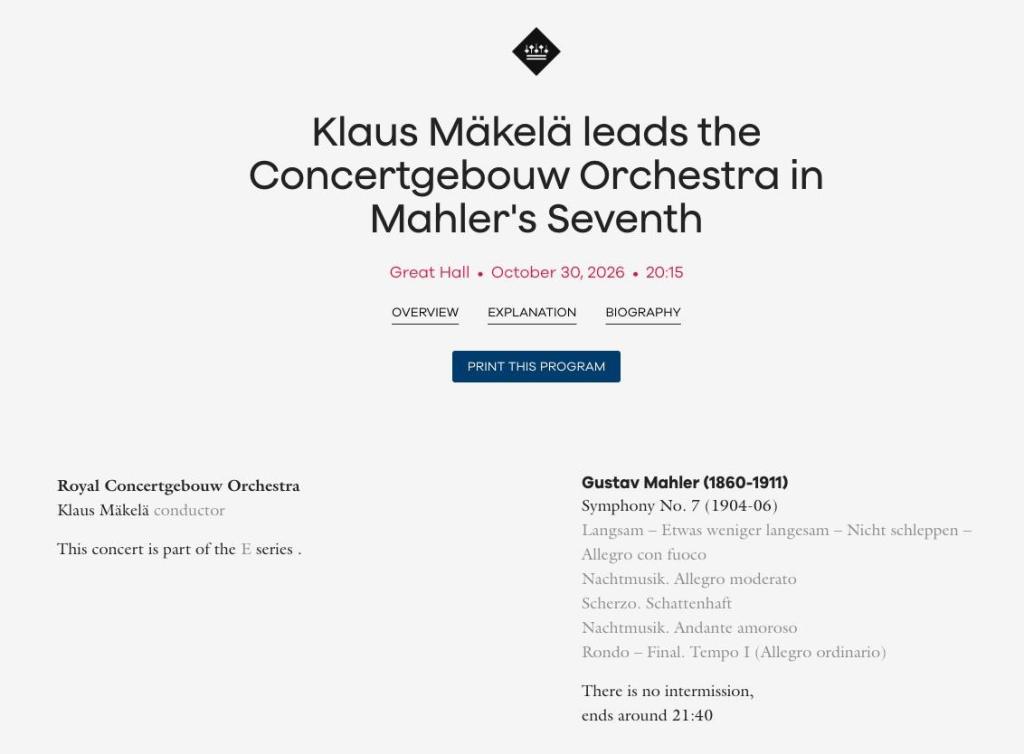
It has been a busy few days for the Royal Concertgebouw Orchestra. After the high of last week’s performance of Beethoven’s Fifth as part of an audio-visual art installation in Amsterdam’s Centrale Markthal conducted by Riccardo Minasi, and the previous night’s celebration of twenty-five years of the orchestra’s Academy programme attended by Queen Máxima, Friday’s performance of Mahler’s Seventh Symphony conducted by their chief conductor designate Klaus Mäkelä, the second this week, both refocused minds and started a trend. A season-long exploration of symphonies bearing the number seven, with those of Dvorak, Sibelius and Beethoven all featuring in the not-too-distant future.
The programme
Klaus Mäkelä conducts Mahler’s Seventh Symphony
From out of the shadows, a rhythmically tight tenor horn immediately set an optimistic tone. Rumbling bass drum and searing trumpet however, painted a rather deliberate response, belying conflict and possible mayhem to come. Restraint was very much the order of the day, mixed with a sprinkle of Christmas sleigh bell wonder. What though, should never be taken for granted, is the level of musicality needed to follow all of Mahler’s intricate performance directions. The discipline required is staggering, especially from the Concertgebouw violins whose unison bows were a visual delight.
The tenor horn solo, so deftly executed by Martin Schippers, really did steal the show. Each iteration with its own tale to tell; the last, much sadder than the one before. And those crystal-clear little notes so rarely heard, whether in performance or even the very finest recordings. Distant trumpet hues reduced proceedings to a blissful halt leaving delicate oboes to take the lead articulating Mahler’s sumptuous harmonies before throaty clarinets gate-crashed the party.
In turn, Mäkelä cleverly crafted an almost sci-fi other worldly existence, the orchestra seemingly hopping aboard Star Trek’s Starship Enterprise until sultry harp glissandi beckoned, and thoughts turned heavenward. Round the corner though, a murky bass trombone lay in wait.
Music of the night
Whilst a rather jaunty Scherzo full of menace and intrigue produced possibly the most uncertain moments of the evening, the two Nachtmusik displayed wonderful control. Bird-like woodwind twitters and the gentlest of triangle tings wafted through the night-time sky. The sight of no fewer than three percussionists jangling on-stage cowbells was pure theatre. I do hope that with microphones out in force, moments such as these will be recorded for posterity. Likewise, shimmering guitar and mandolin quivers full of light and shade to accompany Vesko Eschkenazy’s violin solo and Laurens Woudenberg’s delicate horn response floated effortlessly through the night wind.

© Clare Varney


A defiant tone
In contrast, the Finale set a defiant mood – none dared to breach those fortified timpani walls. Balance and poise remained at the fore even if the rather sedate tempo – ensuring dense contrapuntal textures found full voice in the resonant Concertgebouw hall – prolonged moments of sheer exuberance.
In the full knowledge that ‘everything comes to he who waits’, rich double basses, and horns with bells aloft propelled matters towards a memorable conclusion. Miro Petkov’s sweetest of trumpet tones will live to fight another day.
Audiences are in for a treat next month as the orchestra tours Germany, Luxemburg, Austria and Hungary.
A little history

Look carefully to find an astonishing eleven performance instructions in just the first bar!
© Vesko Eschkenazy | Concertgebouw Orchestra
The archive evidence

Clare reviewed the performance in Amsterdam’s Concertgebouw on Friday 30th October, 2026
Read more from Clare

Klaus Mäkelä and Jennifer Johnston reunite next week for Bartók’s Duke Bluebeard’s Castle

Follow Clare Varney on Facebook or Instagram to read more about Music and Culture
