

Rotterdam conducting competition unveils a rising star. And it may all be down to Barbara Hannigan. So who exactly is conductor Luis Castillo-Briceño and what is he like in the rehearsal room?
Bounding onto the stage like a kid with a new toy, it soon becomes apparent that the young Costa Rican conductor is having the time of his life. As one of the six designated winners of the International Conducting Competition Rotterdam, today’s rehearsal is preparation for a finals concert this evening with the Rotterdam Philharmonic Orchestra. It’s all quite intense!
Delving straight into Debussy’s enchanting La Mer, Castillo-Briceño (28) is clearly a natural on the podium. Technically accomplished and the most authoritative presence on stage all morning, one could even argue that he is the whole package, even if he does occasionally rest his hand on the podium stand. Something we joke about later, recounting the story of how Klaus Mäkelä annoyed Finnish conducting master Jorma Panula, for doing the very same thing!
But technique is not enough. Musicians (and an audience) want music-making to be both fun and challenging. They want to be convinced and taken on a journey however unexpected, and yes, to find the magic.
Inside the rehearsal room
Castillo-Briceño just lets the Rotterdam Philharmonic play, conveying all his intentions through the stick, sprinkled with an odd comment to the cellos so as not to interrupt the flow. Lots of resistance in his arms is encouraging, and for the musicians, his beat is definitely the easiest to follow, helpfully centred around that magic area for a conductor – the face and torso.
A magical end to the movement brings a smile. Watching from the balcony, Han-Na Chang and Vasily Petrenko exchange glances. The judges seem impressed… Will he be able to recreate the magic again this evening?
The atmosphere in the auditorium is electric.
Turning now to Rachmaninov’s Symphonic Dances, Castillo-Briceño’s request for a more full-bodied horn mezzo-forte to “recreate the bells from hell” was met with joyful approval. His, is the most colourful performance so far: dark, satanic trumpets juxtaposed against moments of complete stillness as pianissimo cellos cushion the bass clarinet. The judges scribble furiously. Meanwhile, the first violins led by fellow judge Marieke Blankestijn are grooving and having fun!
What makes a good conductor?
The answer is not simple and while opinions may vary (and with various competitions springing up all over the place) the answer is still unclear. Even the Elbphilharmonie have thrown their hat into the ring, publishing an excellent series of short films asking various ‘all-important’ questions such as: Do musicians have to do everything the conductor says? Baton or no baton? Is conducting exhausting? Do conductors perspire? And how does a conductor practise without an orchestra at home?
Are we any nearer to a definitive answer?
This was the dilemma facing judges in Rotterdam whose decision to jointly award the grand prix award to two candidates, Luis Castillo-Briceño and fellow designate winner, Miguel Sepúlveda pleased some, but perplexed others. As winner of the Classical, Proms and Symphonic prizes, for me, there was just one true winner. Combining boyish charm with an infectious zest for life, Luis Castillo-Briceño is a name we will still be talking about for many years to come.
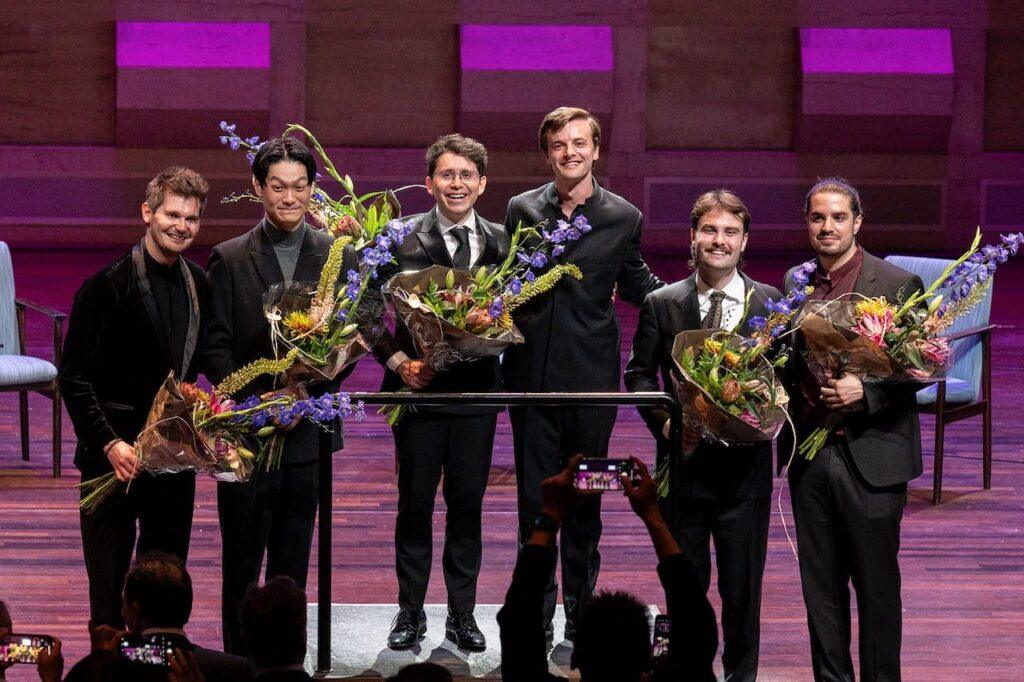
International Conducting Competition Rotterdam | 2025
Jakub Przybycień, Yukuang Jin, Luis Castillo-Briceño, Miguel Sepúlveda,
Sam Weller and Rodrigo Sámano Albarrán
© Allard Willemse
The interview
I chatted to the young Costa Rican conductor after this final rehearsal. Tonight’s concert in De Doelen is the end of an intense two weeks spent working with the Orchestra of the Eighteenth Century, Klangforum Wien, Sinfonia Rotterdam, and finally the RPO for both the opera and symphonic heats. It is his last chance to impress a judging panel chaired by Deborah Borda, President and Chief Executive of the New York Philharmonic.
“It’s really fun,” he says. “And I’m tired, but we are all tired… That’s the job!”
He is pleased with how the rehearsal went, and from the reaction on stage, it’s clear the feeling is mutual. The RPO doesn’t clap AND foot stomp just anyone. After all, this is the Netherlands!
Growing up
I am eager to learn how events in his childhood and musical journey moulded him into the man sitting beside me today, and how the warmth and openness of his Pura Vida (pure life) Costa Rican upbringing permeates all aspects of his life and his work.
He shares how his father passed away when he was just thirteen. “He was a guitar player because the guitar was all his family could afford. However, my father was very determined. He was classically trained, studying both composition and classical guitar in Madrid, so when he moved to Costa Rica, he became curious about traditional folk music.”
Aged just four, Castillo-Briceño started the violin and would play alongside his father in folk bands, both in Latin America but also in Europe, decamping to France for the summer holidays where the whole family would visit various French folk festivals, meeting and playing with musicians from all over the world – from Ghana, China and Bolivia.
This early performing experience I believe is his secret weapon. Because from a young age, he learnt how to please an audience. From the short twenty-five minute rehearsal I witnessed this morning, his innate sense of how to ‘read the room’ is obvious.
The man who made everything possible
Studies on recorder, flute and piano followed, but it was time spent with the late Ukrainian composer, Vladislav Soyfer (who relocated to Costa Rica in 2007) which helped form this young mind. Soyfer, a student of Romanian-born composer Philip Herschkowitz, who in turn was a pupil of Berg and Webern, was a defining influence.
In an excellent ICCR documentary, Castillo-Briceño recounts making a five hour bus trip so he could study harmony and counterpoint with his mentor “and then we went for a swim” in the Pacific – a dramatically different teaching environment to Zurich where he is currently based, just a ten-minute train ride from the heart of the Swiss alps.
Teacher and pupil would talk for hours. Not just about music, but about poetry and history. Soyfer encouraging him always to think deeply; to read philosophy and literature, even Shakespeare, whose plays are a constant source of inspiration to so many musicians.
“I was so lucky to meet him,” he recollects. “Soyfer gave me a first class knowledge of music and without him, I would still be in Costa Rica. We studied so much.”
Meeting Barbara
For such a learned young man whose Maths teacher similarly introduced him to the works of Plato aged just fourteen (reading material not typically found on the Maths curriculum in the UK… ) studying conducting and the piano in Zurich and Vienna was a natural step.
I wanted to learn more though about his connection with Barbara Hannigan, fostered by Mark Stringer, his professor in Vienna, and how he came to be part of her mentoring scheme.
“Barbara was looking for an assistant, and I was just lucky enough that she chose me,” he says.
Working as an assistant conductor
Again the documentary, we see the pair working together in the Isarphilharmonie as Hannigan rehearses the Munich Philharmonic. Chatting early in the morning, Castillo-Briceño suggests that a certain passage needs more time. Hannigan needs no convincing – she is sold.
“I was looking for an assistant with a Swiss orchestra,” Hannigan says. “And I saw this video of Luis conducting… and I thought, ‘That’s him, that’s the one I want!’ because he had an open energy. He clearly made music with joy and playfulness, he loved what he was doing, and he was authentic to himself.” She signed him up without actually meeting in person. The job was his and they were “immediately at ease”.
Castillo-Briceño tells me just how important such a role truly is. Having worked with Hannigan since the age of twenty-four, suddenly she gave him invaluable access to numerous top orchestras. “It’s just priceless!” he says.
His role as assistant conductor is to be another pair of eyes and ears for Hannigan during rehearsals, producing instructions such as ‘not to rush’, ‘to play the duplet together’, or ‘to create more transparency for the trumpet’.
Hannigan in turn loves working with him and watching him grow. “I’m excited to see where he’s going and how he’s getting there. Orchestras react positively and get excited,” she effuses. “They want to play with him!”
But the role of assistant conductor is nothing new and many conductors may have similarly close working relationships with their students, so I delve deeper and ask:
What has Hannigan given you?
His eyes sparkle.
“Everything!” he says. Barbara gave me everything, because she opened the door.”
“As a young conductor, you need to be lucky and to be in the right place at the right time. You need someone to give you the opportunity and tell you ‘I trust in You’. Barbara has done that for me. She has opened the door to so many new experiences.
“She’s not a traditional conductor. But that’s even better, because then you realize what’s really important. You understand why all these orchestras love her. She makes a connection with them, she makes music with them, and she takes them seriously, and with humility. And it’s a dialogue which has evolved into a beautiful personal and professional relationship both as friends and as colleagues.“
Working in London and Los Angeles
Time spent working alongside Ed Gardner at the London Philharmonic and Gustavo Dudamel at the LA Philharmonic over the past two seasons have also helped.
“I’ve learnt how to work with orchestras at a professional level. To know what they need and what they don’t. How to manage the time. What to say, and what not to. It’s just evolved. meeting Daniel Harding and Barbara Hannigan – you just talk with people who have a huge impact.”
The competition
For a young man who takes the whole process of conducting seriously, spending hours analysing scores and trying to figure out a composer’s intentions, the Rotterdam conducting competition seems to have come along at just the right point in his career, even forgoing the recent 2025 Mahler Festival in Amsterdam to prepare for this competition. “I’ll go to the next one… in twenty-five years!” he promises.
With all the team building events and time spent meeting leading professionals, I ask what he feels he has gained from the experience?
“I love that we have been supported for a whole year. We’ve grown together as colleagues,” he tells me. “Travelling, meeting orchestras and attending rehearsals. It has just been so enriching, and because it’s been a whole year, hopefully we are much more mature, more in charge! Everything has gone so smoothly.”
What does the future hold then for this talented young man?
“I have no idea! One never knows. Ten years ago, I was in Costa Rica and hadn’t even started my studies. Of course we all hope to find a chief position in a small orchestra where we can start to build repertoire. But most of all, I just love making music. To bring the warmth and openness of Costa Rica’s Pura Vida (pure life) into the concert hall. To give as little, or as much as I know.
The conducting world has a new rising star. Watch this space!
Read more from Clare


This rehearsal took place in De Doelen, Rotterdam on Friday 13th June, 2025
Follow Clare Varney on Facebook or Instagram to read more about Music and Culture

