

Håkan’s running late… I receive an email to say he’s on his way. And true to his word, just a few minutes later, I meet the Swedish trumpet legend, Håkan Hardenberger backstage at Cologne’s Philharmonie where he will perform later that evening with the Royal Concertgebouw Orchestra (RCO) and Jukka-Pekka Saraste.
Completely unprompted, he recalls our previous meeting three years ago after one of his rare Christmas concerts with soprano Johanna Wallroth and the Amsterdam Sinfonietta. Dressed casually in a navy jumper and jeans, he enthuses about the Dutch premiere of Jörg Widmann’s Trumpet Concerto in Amsterdam the previous evening and how he just loves being around the RCO. ‘They’re all so happy and enthusiastic. They’re a great bunch of people!’
There is a rare honesty in his communication. Artists today are so used to being careful, not only with their words but also with their mannerisms and body language, that this honesty of expression feels remarkably refreshing. Likewise, on stage Hardenberger lays the trumpet bare, using raw emotion to draw an audience tight and leave them wanting more. Is this the key to his longevity and a career spanning over forty years with a list of composers who have written works for him reading more like a who’s who of the contemporary classical world? Is his ability to convince even the most sceptical audience that the fiendishly difficult and sonically challenging is worthy of our attention, the secret to his success? Can we ever hear enough Håkan?
Staying at the top
We start with a question musicians always want to know: Does he have a rigid practice routine, and how has he managed to maintain his playing to such a high level over so many years?
“I keep fit,” he says. “I swim a lot! I swam a couple of kilometres this morning. But in my trumpet practice, I go back to basics every day as if I was a beginner.”
But what are his basics? Is it just simply playing long and slow?
“It’s all the disciplines,” I learn. “Strength and flexibility, air and vibration, fingers and articulation, and the balance between the two. It’s keeping the whole in place which sometimes takes an hour or two every day before I even look at the music. Last night after the concerto while the orchestra played Mahler’s Fourth Symphony, I repaired my lip, and I will do the same tonight. There is a lot of discipline involved. This is where my colleagues and students often fail.
“Students don’t realize how much work is needed,” he continues. “Not just warming up and warming down, but also gaining those skills in the first place. My teacher used to say that: ‘For the trumpet, one lifetime is not enough!’ And he was probably right.
“First you have to gain control of those skills, but then you have to keep them. You can never take them for granted. Professionals are pushed for time – you have a life, children and things you have to do. Sometimes it’s hard to keep that discipline.”
So how does he keep all these skills in such good shape?
He explains that he bases himself on the Max Schlossberg / James Stamp tradition, “but it’s not that simple. Early in my career, I chatted with a couple of trumpet players over breakfast, and they wanted to know exactly what you’re asking. Seated alongside was a rather cynical Polish concertmaster.”
“‘Guys,’ he said. ‘It’s not what you play, it’s how you play it!’
“Your ears are of course the most important tools that we have, but it’s how you play that matters. Knowing your own playing and having a clear idea of what you want to achieve, is the most important thing. Once you are clear about all of this, you can find the tools, the methods, or the thoughts that will help you achieve your goal.”
Håkan’s sound
The creation of sound is an interesting one for artists, especially interpreters of works created predominantly in the last fifty years where composers push an instrument’s range and capabilities in dizzying directions. Does he aim to create a definitive and instantly recognizable sound?
“I’m told that I can be recognized on the car radio quite quickly,” he replies. “But I aim to create a whole palette of sounds and colours. I really have to thank my first teacher for that. He pulled it out of me from the very start.”
I press the point… Can he define his own sound? “Well… that’s like looking into someone’s eyes and saying, ‘What is that?’ I cannot put ‘that’ into words.”
Creating a legacy
This leads us nicely to an interview ten years ago with Berlin Philharmonic’s Sarah Willis in her Horn Hangouts, where she quite rightly congratulates Hardenberger for extending the trumpet repertoire “beyond all belief”.
Did he consciously look to expand the trumpet repertoire, or did composers approach him?
“Both!” he retorts. “In the beginning, I knew that if I wanted to be a soloist, I couldn’t just play Haydn and Hummel concertos for the rest of my life. My career wouldn’t have lasted over 40 years. I wanted to tell true, big, deep and important stories. So rather like the six actors in the 1921 play by the Italian author Luigi Pirandello: Six Characters in Search of a Play, (1921) I’ve been in search of stories to tell.”
And has he found many stories to tell?
“Oh yeah!” Jörg Widmann’s Towards Paradise inspired by Miles Davis and commissioned for his 60th birthday season “tells a big, big story. The trumpet has that quality with composers. There’s no hiding. Writing often becomes very honest and autobiographical. We don’t have the historical legacy of a Brahms or a Beethoven concerto, so there’s no heavy luggage. The trumpet can mean very different things to different people.
New commission with Unsuk Chin
“My next big commission is with Unsuk Chin. And for her, the trumpet means something completely different: it has to yearn.”
Co-commissioned by six institutions – The New York Philharmonic, Royal Stockholm Philharmonic Orchestra, Orchestre Philharmonique de Radio France, The London Symphony Orchestra, Symphonieorchester des Bayerischen Rundfunks and the Danish Radio – and in light of Chins’ recent award celebrating her ‘unique technique’, the world premiere should be quite an occasion.

And, as he argues, it doesn’t matter that many of these new commissions are fiendishly hard. “It’s normal for new works to lay dormant for a while. Bernd Alois Zimmermann’s Nobody Knows the Trouble I See, written in 1954 lay sleeping for thirty years because nobody thought they could play it”.
But suddenly, “it isn’t unplayable”, and young people are taking up Aerial by HK Gruber (which he has performed over 100 times) and Brett Dean’s Dramatis Personae (2013).
“It just takes a little time.”
What is the hardest work he’s ever played?
“It’s the Widmann, because it’s on the lip for 37 minutes!” Which in brass terms, is a very long time!
Trumpet Concerto ‘Towards Paradise’,
and how they sent ideas backwards and forward
The Dutch premiere of Jörg Widmann’s Trumpet Concerto ‘Towards Paradise’
Thinking again of his concert the previous evening in Amsterdam: “I had dreamt of playing this concerto in the Concertgebouw, a venue full of possibilities. Last night, I started off stage, but when they opened those huge doors, I was in complete darkness (as per the composer’s instructions). And then, there are the stairs… You still have to remember what to play!
“In the beginning when it’s dark, I’m all alone, searching for the accordion before the magnificent sound builds up. The orchestral interludes are quite brutal, but we have these glimpses of paradise which I don’t think I ever reach. Maybe that’s what we need to learn. If we can take the time, paradise is actually in front of each of us. Moments we should treasure.”
What does he enjoy about playing the trumpet?
You must still find the joy, I ask? “I’m lucky, I love practising and I wouldn’t be without it. I also love performing. Practising and performing come as naturally to me as eating and sleeping. It’s what I have to do.”
I wonder what attracts him. Is it just the discipline?
“It’s finding the sound, but also the routine. My wife tells me that I am someone who searches for routine. Probably practising taps into this side of my character.” Like Stravinsky famously said, it seems that he too ‘finds creativity within restraint’.
I ask how he copes in those moments when he’s not feeling so well, or there are other things on his mind. Does he have any strategies?
“I do have some sort of turbo that has saved me many times, but this is a dangerous thing to count on. There have been moments in my career where maybe I should have cancelled. On the other hand, life is life! We can’t only count the days where you feel perfect. You have to get on with things and adopt the British stiff upper lip!
“Maria Callas once said: ‘The audience has not paid to see us try.’
“You can feel absolutely perfect but not have such a good night. Or feel a little scrappy and have a really good performance. But if you stop practising, you will make mistakes and have ups and downs. I soon realised that I was never quite happy.”
I suggest that musicians are some of their own harshest critics.
He agrees. “If my goal was always perfection, then I should find another profession.”
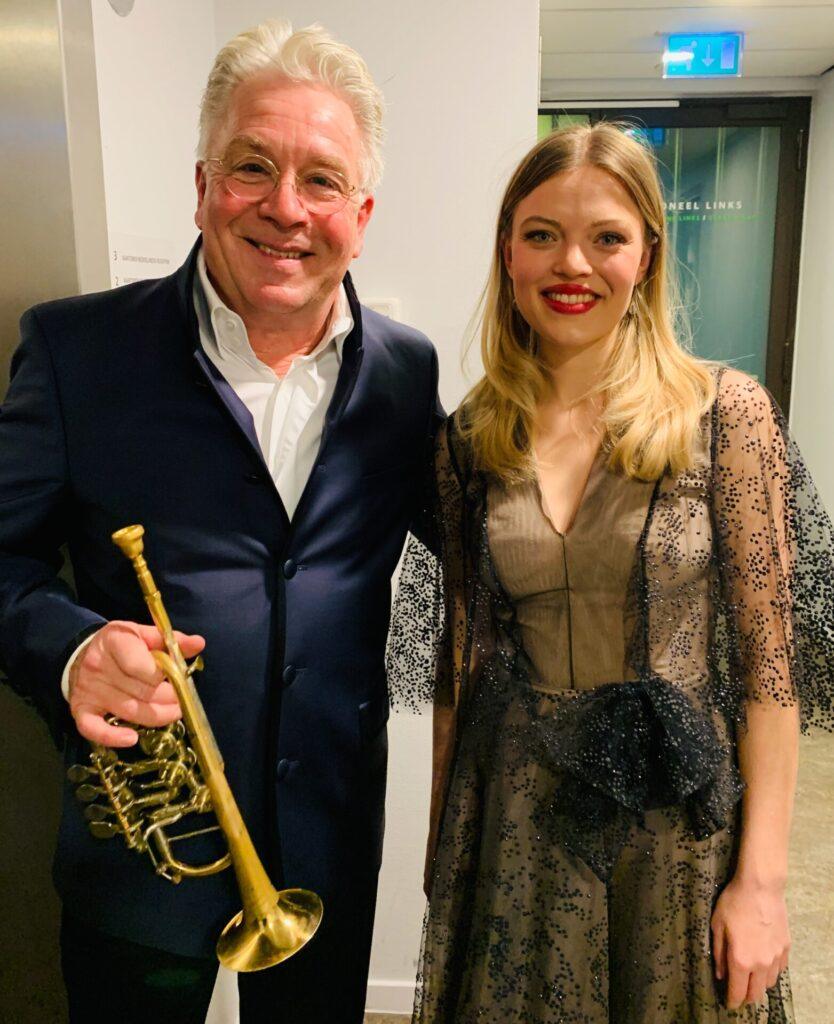
© Clare Varney
Final thoughts
When researching, I came across an interview for Amsterdam’s Muziekgebouw aan ‘t IJ where Hardenberger talked about the music industry valuing marketability over quality. Does he still hold this opinion? And what advice would he give to young brass players entering the profession, including former pupil Matilda Lloyd who joined the Kölner Philharmonie audience later that evening?
“To absolutely find what they want to say. I’ve played Birtwistle’s Endless Parade at the BBC Proms three times, but it’s so much harder now. Today’s business often values short term financial considerations over music as an actual art form. If we want to gain people’s attention and to touch their deepest feelings, then music needs to be more than just entertainment.
“I see my role as making music and doing the things I like. And I hope that people come along.”
Smiling broadly, he continues: “I usually say that I’m old enough to be a modernist. So while promoters still book me for Birtwistle’s modernist masterpiece, when booking young trumpeters, they prefer Haydn instead. If the industry has not moved on in fifty years, then my efforts will have been in vain. I don’t envy the young generation. When I started out, I was lucky: the path was clear. The CD had just been invented and everything needed to be recorded. After this, the offers started flowing.”
As we wind up, and he laments the days when you could offer dinner guests your latest CD, ever the consummate professional, Hardenberger queries if I have checked out his recent record release: Autumn Aubade with Roland Pöntinen which includes favourites from the great American songbook.
“It had a very good review in BBC Music Magazine!”
You can hear Håkan Hardenberger play Jörg Widmann’s Towards Paradise with the Oslo Phil on May 7th, 2026
Read more from Clare


Follow Clare Varney on Facebook or Instagram to read more about Music and Culture

