

The recent trend for soloists to take increasingly prominent roles in concerts comes in many guises. American violinist Joshua Bell travels all over the world directing the Academy of St Martin in the Field with his violin in tow, while pianist Yuja Wang as Mahler Chamber Orchestra’s artistic partner, will later this month embark on her very personal marathon, performing and directing both Brahms concertos.
The programme
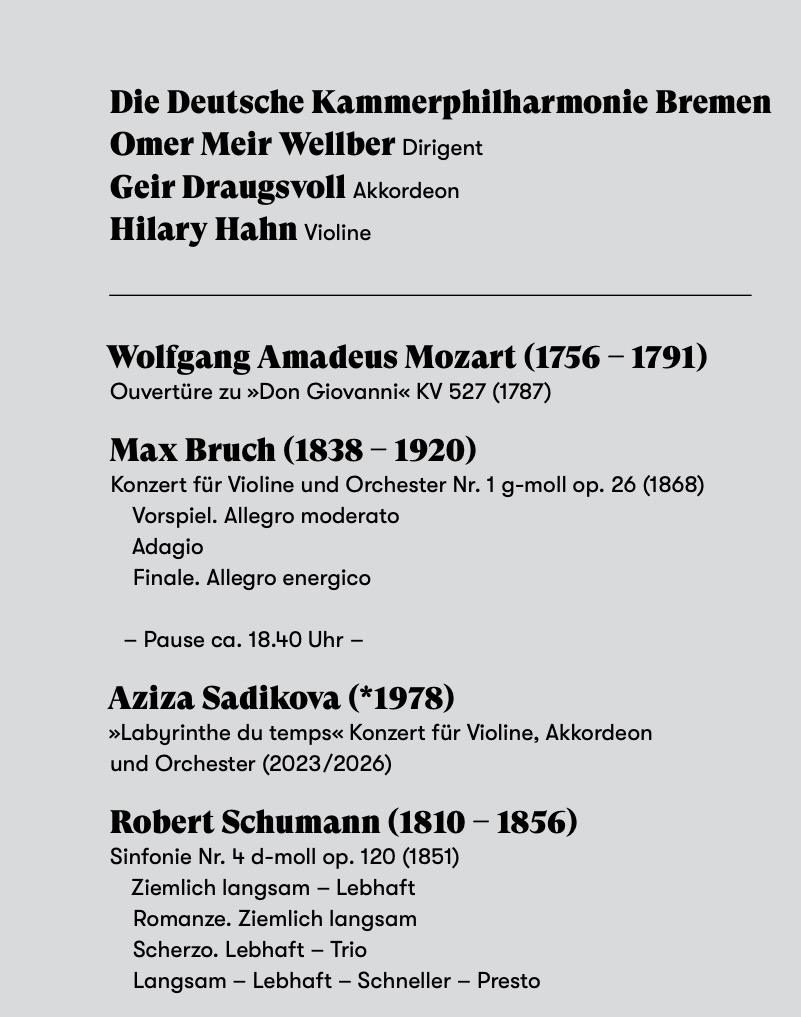
Hilary Hahn’s contribution to this phenomenon with the Deutschse Kammerphilharmonie Bremen (DKB) is equally attractive whilst also providing an insightful window into the history of the violin and future possibilities. First, a romantic and intense reading of Max Bruch’s Violin Concerto no.1 followed by something a little different, Uzbek-German Aziza Sadikova’s new Labyrinthe du temp for violin, accordion and orchestra with virtuoso accordionist Geir Draugsvoll which they premiered earlier this year in Villach, Austria.
The new concerto
Reuniting again tonight, their colourful opening cadenza was as one. With the addition of bowed crotales, their ethereal, almost ghostly presence cast the accordion as Hahn’s Doppelgänger, chasing all in sight before carefully covering his tracks. Billed as a fusion of Baroque with more unusual sounds, frequent shifts in mood between Steve Reich-like minimalism recreated a very modern New York, harsh metallic underworld. Desolate, icy vistas reverberated around single, oscillating notes while intense Baroque-inspired violin string crossing painted a very tempestuous tale. Deafening snare and tubular bells called a halt to the madness. This had been quite a journey. To where, we may never know.

From an audience perspective, this trend of increased soloist exposure is to be applauded. The packed Konzerthaus Dortmund audience had turned out in their droves to see Hahn, and with the added bonus of J.S. Bach’s Sarabande from his Partita no. 2 as encore, full of tender falling sequences and wanton open-ended phrases, Hahn’s pocket-sized history of the violin possessed the power both to inspire and enthral.

Bookending proceedings, a terrifying Don Giovanni conjured dramatic scenes from Peter Shaffer’s 1984 film Amadeus. Its very sprightly opening, matched by an even more sprightly Allegro, left violins gasping for breath.

Concluding as they had started, Omer Meir Wellber’s dynamic, detailed reading of Schumann’s Symphony no. 4 full of charcoal intensity, created moments of Wagnerian suspense. With raucous horns dominating proceedings a little too much, Wellber’s full-throated and at times wild interpretation was at times something of an acquired taste. Nevertheless, this hugely varied programme was a hit in Dortmund. The audience loved it.
Read more from Clare


Follow Clare Varney on Facebook or Instagram to read more about Music and Culture
