

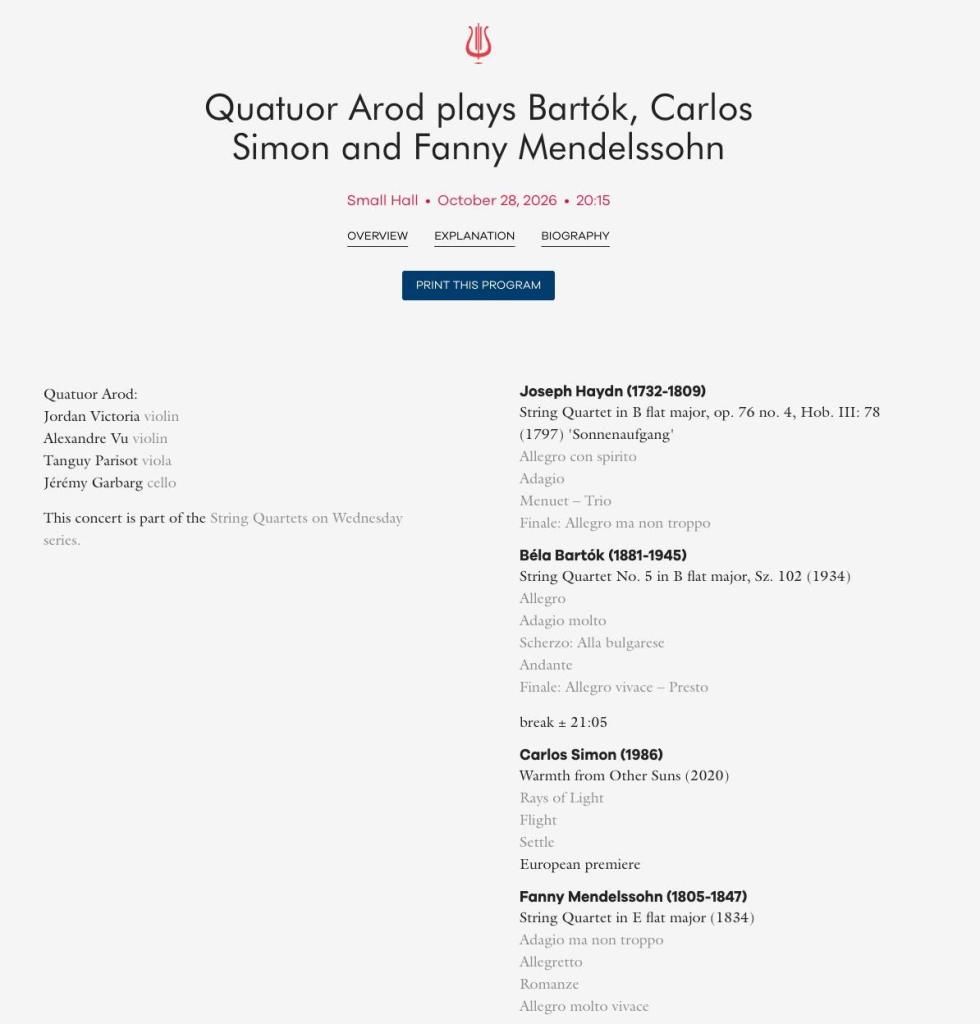
Super talented Arod Quartet returned to the Concertgebouw for a programme of Haydn, Bartók, Carlos Simon and Fanny Mendelssohn. With Klaus Mäkelä conducting the first of many performances of Mahler’s Seventh Symphony with the Royal Concertgebouw Orchestra next door in the Grote Zaal, the slightly smaller than usual audience were nevertheless treated to this promising young French quartet’s trademark eclectic mix, and what a treat they had in store.
The programme
A little Haydn
Using recently commissioned classical bows, the opening of Haydn’s Op. 76 no. 4 affectionately known as ‘Sunrise’ conjured a new and glistening world. One where opaque clarity reigned supreme. A delicious viola countermelody and lingering, luscious cello dissonances in turn gave way to ghostly apparitions. Their Adagio seemed to seek a previously unheard eternal truth, before a charming and slightly drunken Minuet and Trio took hold – its slightly delayed second beat adding attractive rustic charm.
As the Haydn unfolded, the mood in the room visibly softened, for as I said when I first heard them at the String Quartet Biennale Amsterdam earlier this year, the Arod Quartet is quite simply in a class of its own. Their obvious delight in Haydn’s humour, despite having played these quartets many times since recording the entire opus last November, was joyous. But it was the Finale’s fragile opening, unleashing a quasi-improvisatory cheekiness, that really impressed. Daring each other to hurtle towards the end whilst sitting beneath Haydn’s gaze – his name emblazoned on the wall above – was just sublime.
No escape from Bartók’s angst
Bartók’s Quartet no. 5 was a completely different proposition. Taking up their more modern bows, Bartók’s fearsome angst vied with passing jazzy hues and fleeting desolate wastelands before sultry harmonies tinged with a touch of the American Wild West accompanied Jordan Victoria’s soaring violin melodies. Their skill at unpicking Bartók’s dense and highly complex score was dazzling, making light work of the Scherzo’s complex and fluctuating time signatures, offering instead a compelling jazz-inspired medley before quivering scales took hold. Jérémy Garbag’s cello riff’s now the sole words of reassurance.
Glissando pizzicato popped like balloons floundering in the heavenward sky, before ricochet bows calmed the seas. Angst, though reappeared at every turn, comically interrupted by Alexandre Vu’s naive nursery rhyme, literally butchered by Victoria’s clashing reprise up the octave but now a semitone higher. Their obvious flair and intellectual understanding of Bartók’s complex landscape is hugely impressive. I am eager to hear more.
Carlos Simon, the Concertgebouw Composer-in-Residence
In conclusion, two lighter numbers. First the European premiere of Carlos Simon’s Warmth from Other Sun transported the narrative to wide American plains, far from the madding crowds. Sadly, it seems Amsterdam does not quite hold the same allure for the current Concertgebouw Composer-in-Residence as it did for Gabriela Ortiz who last year became a familiar face across the city. Simon tonight, was resident in name only. Fanny Mendelssohn’s Quartet in E flat opening with a deeply emotional love song before the contrapuntal Allegretto, closed the evening on a high, or so we thought… Squeezing in a little more Haydn taken at breakneck speed – the finale of Opus. 76 no. 5 – simply dazzled.
I would cross borders for these boys; they are so good.
Clare reviewed the concert at the Concertgebouw on Wednesday 28th October
Watch this video where the Arod discuss their approach to recording Haydn’s late string quartets, their new bows and how they created authentic sounds on metal and not gut strings. Jordan Victoria’s cute little dog Charlie even joins in the fun.
Read more from Clare


Follow Clare Varney on Facebook or Instagram to read more about Music and Culture
